

Network Effect can simply be described as when every new user or additional customer that comes onto a platform adds value to that product or service for the existing customers. Meaning the more users, the better the value of the product to the customer. Nfx.com furthers explains that with network effect, “Every new company makes the others stronger”.
According to Wikipedia, a network effect (also called network externality or demand-side economies of scale) is the effect described in economics and business that an additional user of goods or services has on the value of that product to others. When a network effect is present, the value of a product or service increases according to the number of others using it.
Caroline Banton in her article on investopedia.com also described network effect as a phenomenon whereby increased numbers of people or participants improve the value of a good or service.
Indeed, a great example of the first network effect in practical terms, is the introduction of the telephone, where two people having a telephone, is of benefit to only the two. However, the more people having the telephone, is of more the benefit to all telephone holders. Another great example of network effect in practice is the internet.
Often there are misconceptions around network effects, viral growth is often confused with engagement. Rather, the network effect is about creating value and retention.
It is important to note that network effect is native to the digital age. The other defensibility for digital organizations apart from network effect includes:
1. Scale effect – an example is Amazon, a brand which has done a lot work to get to the size that they currently are, and therefore their price and efficiency is great. Everyone wants to use Amazon’s platform.
2. Embedding – this is where the organization embeds Software as a Service (SaaS) into a platform or behaviors for Oracle, Open Table, Microsoft
3. Brand Associations- Social Acceptance and Fitting in. In other words, people have a desire to fit in, whether at school, work or in social circles. For this reason, people sometimes buy or use brands because they believe and trust that the brands will contribute to greater social acceptance. A great example is Google, Uber, IPhone etc. At this point the brand becomes a noun, for example ”Google something”
Network effects are very powerful due to their mathematical implications. This is indeed, effectively argued by Metcalfe’s law, which states the effect of a telecommunications network is proportional to the square of the number of connected users of the system (N raised to the power 2). First formulated in this form by George Gilder in 1993, and attributed to Robert Metcalfe in regard to Ethernet, Metcalfe’s law was originally presented in 1980, not in terms of users, but rather of “compatible communicating devices” (for example, fax machines, telephones, etc.).
Only later with the globalization of the Internet did this law carry over to users and networks as its original intent was to describe Ethernet purchases and connections. (Wikipedia)
Arguably, Facebook has built six of the fourteen known network effects to create defensibility and value, like a castle with six concentric layers of walls. Facebook’s walls grow higher all the time, and on top of them Facebook has fortified itself with all three of the other known defensibilities in the internet age: brand, scale, and embedding.
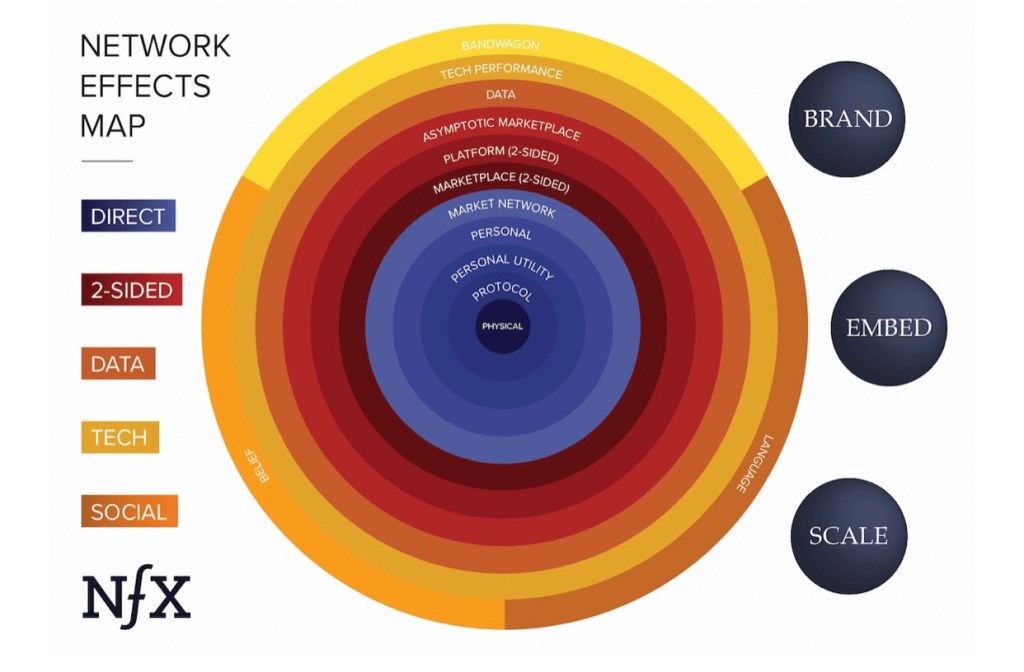
1. Physical Network Effect – This is a direct network effects tied to physical nodes (e.g. telephones or cable boxes) and physical links (e.g. wires in the ground).
2. Protocol Network Effect – This arises when a communications or computational standard is declared and all nodes and node creators can plug into the network using that protocol. Bitcoin and Ethereum
3. Personal Utility Network Effect – There are two distinguishing qualities. The first is that users’ personal identities are tied to the network in question, often with usernames tied to their real name as with Facebook Messenger. The second is that they are essential to the personal or professional lives of users on a daily basis e.g. WhatsApp.
4. Personal Network Effect – This is when a person’s identity or reputation is tied to a product. Often people on a Personal Network are influenced to join by people they might know in real life. e.g. Facebook.
5. Market Network Effect- This combines the identity and communication aspects of a Personal Network with the transactions focus and purpose that typify a marketplace. Usually, Market Networks start by enhancing a network of professionals that already exists offline, e.g. HoneyBook, AngelList.
6. 2 Sided Marketplace Network Effect – This is defined as “indirect network effects” in academic literature. However, we think this is misleading since 2-sided networks can involve both direct and indirect network effects. Instead, the real distinguishing characteristic of a 2-sided network is that there are two different classes of users: supply-side and demand-side users. They each come to the network for different reasons, and they produce complementary value for the other side. E.g. eBay, Craigslist)
7. Platform Network Effect – This is usually called a 2-Sided Platform as they are similar to 2-Sided Marketplace, in that they have two sides with very different interests that directly benefit from each other. The difference is that the supply side actually engineers products that are only available on the platform. The supply side has to do work to integrate to the platform. The products created and sold by the suppliers are a function of the platform, not independent of it. E.g. Windows, iOS, Android)
8. Asymptotic Marketplace Network – The two 2-Sided Marketplaces are exactly the same as Asymptotic marketplace however, one way, this significantly differ is in the “value curve.” This refers to how fast the value to the demand side increases as supply increases, and how strong the nfx gets when critical mass is reached.
9. Data Network Effect – This is when a product’s value increases with more data, and when additional usage of that product yields data, this is further used to optimize the product or service, for example Waze, Yelp!.
10. Tech Performance Network Effect – When the technical performance of a product directly improves with increased numbers of users. In other words the more devices or users on a network, the better the underlying technology works. This makes the product/service become faster, cheaper or easier e.g. Bittorrent, Skype
11. Social Network Effect – This works through psychology and the interactions between people. In essence, Networks are nodes and links. For example a landline telephone system, it’s easy to see the physical phones and wires connecting. However, there is an unseen network among people, where our physical bodies are the nodes, and our words and behaviors with each other are the connections. Hence, social networks. This social network effect can help create more value in your product for users the more people use it. People add value to each other by influencing them to think or feel differently. By providing triggers and confidence to use your product. By reinforcing their choice to continue using your product.
12. Language Social Network Effect – In any human network, language is the main intermediary. It’s the protocol that all the nodes in a network use to interface with each other. For instance, the English language is a serviceable language, but it’s a lot more valuable considering that there are 1.5 billion people who speak it. That’s more than 15 times as many people who speak German. So even though speaking English doesn’t make you 15 times better at communicating than speaking German, the value to speakers is much higher as a result of the network. e.g. Google, Uber.
13. Belief Network Effect – This is something you can best see with gold, Bitcoin and faith. People believe even if they haven’t seen.
14. Bandwagon – This happens when social pressure to join a network causes people to feel like they don’t want to be left out. For example Apple iPhone and its ecosystem.
Harnessing the Power of Network Effects
1. Build product that democratize value. In other words, create a differentiated and unique value proposition to all network users
2. Partner with industries that build complementary products.
3. Build an effective business model- that is tailored to customer segments, and dominate.
4. Develop a go-to-market strategy to address the niche that validates the model.
5. Increase the economies of scale on both the supply and demand side by delivering innovative products to consumers on the demand side and offer cutting-edge technology to the supply side.


 Growth Journey By Frank A