
Imagine you can walk into a shop, order an item, have it customized, and after a couple of hours, you pick it up. In fact, imagine you can go into a cell phone shop, order an iPhone, and have it customized with your favorite features, such as; the camera quality, battery life, your preferred level of processors, etc. With this you get to be part of the production team and pick up your phone in a couple of hours.
As a result of digitization, this figment of imagination is actually real and happening today. This digital revolution has completely redefined OEM (original equipment manufacturer) business model in all industries. This is actually in vogue in all industries including electronics, industrial equipment, medical equipment and importantly the automotive industry.
Indeed, in the last decade, going digital has impacted every industry. For example,
1. Taxis has been disrupted by Uber & Lyft
2. Stereo systems disrupted by Alexa, Google Assistant, Apple homepod
3. Cameras and cellphones disrupted by iPhone
4. Watches disrupted by smartwatches.
Digital impacting on business models
It is important to note that digital is redefining business models from CAPEX to OPEX. This has indeed changed the traditional operating model of OEMs which was designed to optimize the push of pre-packaged products to customers via large up-front deals.
Capital Expenditure (Capex) model in any business is usually aimed at getting the maximum benefit out of any product or asset sold to the customer.
It is now a fact that digitization is enabling customers to pursue operating expenditure (Opex) consumption model, which doesn’t call for large up-front capital.
One such digital OEM revolutionizing the auto industry is Local Motors.
Local Motors, (is an American motor vehicle manufacturing company) focused on low-volume manufacturing with a business model of Design, Build and Sell.
In other words, they say at Local Motors, that they…
1. Design with the open-source community
2. Build in multiple micro-factories.
3. Sell by giving the consumer a new buying experience.
The company through the concept of collaborative innovation (or co-creating and partnership), chemical engineering and 3D printing is able to assemble a car in 8 weeks. This is what is called ”speed to market”.
The term “speed to market” refers to the length of time it takes for an organization to manufacture a product or service and make it available to the customer.
At Local Motors, for example, the brand views this as the building of ”Agile Hardware”. Admittedly, there isn’t enough literature on agile hardware but suffice to say it’s akin to agile software.
1. Design with the open-source community.
The Design with the open-source community concept approach, in this approach of developing software, requirements, and solutions is when a three-party team is formed, made up of the self-organizing, cross-functional teams and the customer/end-user. They work collaboratively to churn out the product.
It’s important to note that all Local Motors products are open-sourced.
The term Open Source was originally associated with software development.
The definition was taken from the exact text of the Debian Free Software Guidelines, written and adapted primarily by Bruce Perens with input from the Debian developers. According to Wikipedia.
Today, with the advent of digitization, almost everything can and is openly sourced. An example of Open-sourced website software is WordPress, for blog hosting.
One of the reasons why Local Motors was successful as the first Digital OEM (Original Equipment Manufacturer) is because of the collaborative innovation or Co-creation approach it attaches to the design of its products.
Collaborative innovation is a process in which multiple players (within and outside an organization) contribute to creating and developing new products, services, policies, processes, or business solutions. It might include the involvement of customers, suppliers and multiple stakeholders such as agencies and consultants.
Local Motors has over 200k people in community members and is able to design with a Siemens CAD (computer-aided design) software to create, analyze 3D designs and models in a digital environment and delivers cloud capabilities simulation as well.
In other words, Local Motors’ design process involves a community of designers, engineers and car lovers. It is true that consumers play a central role from beginning to end of the product.
Another example of openly-sourced food is Soylent. It is a brand of meal replacement products made by Soylent Nutrition, Inc. Soylent was introduced in 2014 after a crowdfunding campaign. It’s said to be openly-sourced because the formula for the powder has been openly obtained on the internet since it was founded. They keep the powder formula available so that communities can experiment with customization.
2. Build in multiple micro-factories.
A micro factory production strategy is an approach in which appreciable amount of capital investment is made into a factory. A factory the size of a shopping mall. They don’t mass-produce and their quality is at Six Sigma (it’s a set of techniques and tools for process improvement).
The benefit of using a micro-factory also includes being 5X faster and using 100X less capital required to build the factory. Micro factories are easy to replicate, hence multiple factories.
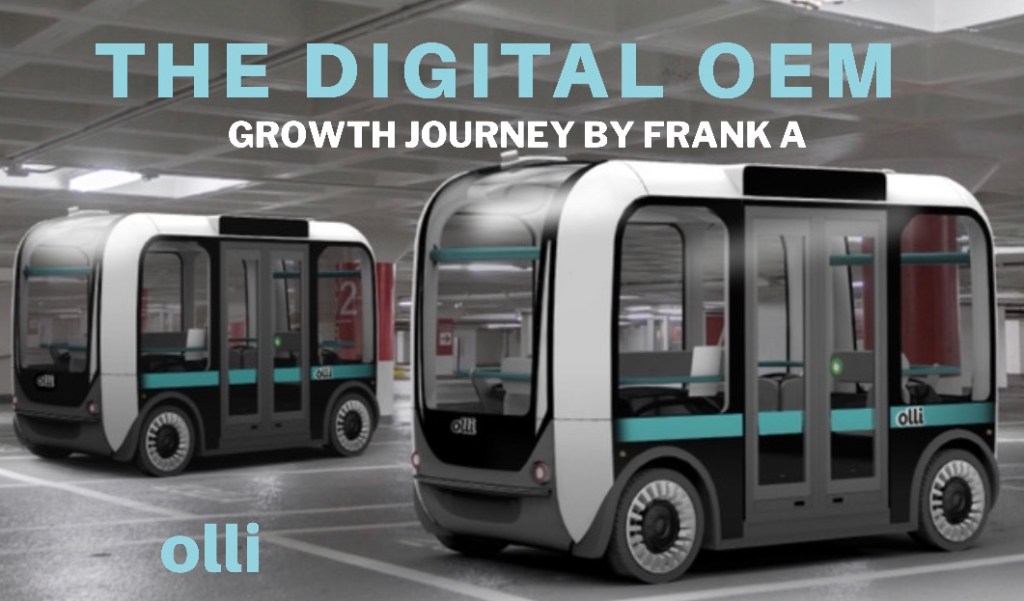
Local Motors also partners with many other industries. For example, in the “Ollie” (an autonomous electric-powered shuttle) the cognitive artificial intelligence, was from IBM, “the Watson”. They also went for Goodyear’s “nomadic tyres”. Other partners include Bosch, Protean and Eastman just to name a few all went into partnerships
3. Sell by giving the consumer a new buying experience.
This model of selling by giving the consumer a new buying experience aims at customization of the product, whilst providing a delightful shopping experience. In other words, the consumer can customize the product with the exact features he or she wants. By extension not paying for anything not needed.
This is not the case in mass production. That is, this allows the consumer to enjoy what they want, including the latest technologies.
A great example is iPhone coming in June 2007 to charge $499 for the 4GB model and $599 for the 8GB model has sustained an EBITDA margin of 38% to date. Before then Nokia and Motorola were selling their phone with an 8% EBITDA margin.
Lastly, for any reason, if you don’t like your car… for example, your family size has changed, or you want to add a new feature. You return the car to the manufacturer to be recycled and rebuilt. If you choose to be part of the production, you are allowed. This is however not possible now in many automotive manufacturing companies such as, Toyota, Kia, Mercedes-Benz, Rolls Royce, just to mean a few.
Before I take a bow, a few of the lessons that I takeout;
1. For an OEM to go digital, it requires a new business model.
2. Digital requires constant improvement to enhance agility or speed to market.
3. Partnership is key in creating a unique customer/user experience in the digital age.
4. Experimentation, iteration, and correction of solutions increase efficiency that reduces the cost of development to zero.
5. Finally, “first principal thinking” is a prerequisite for innovation.
Credit:
This article was written with the inspiration and content from
• John Rogers, Jr.-CEO & co-founder of Local Motor
• Vele Galovski – Vice President – Technology Services Industry Association (TSIA)
• Wikipedia, the free encyclopedia.

 Growth Journey By Frank A